
Palabras clave
Crisoles refractarios
Tratamiento térmico
Propiedades mecánicas
Microestructura
Materiales de fabricación local
Cómo citar
Resumen
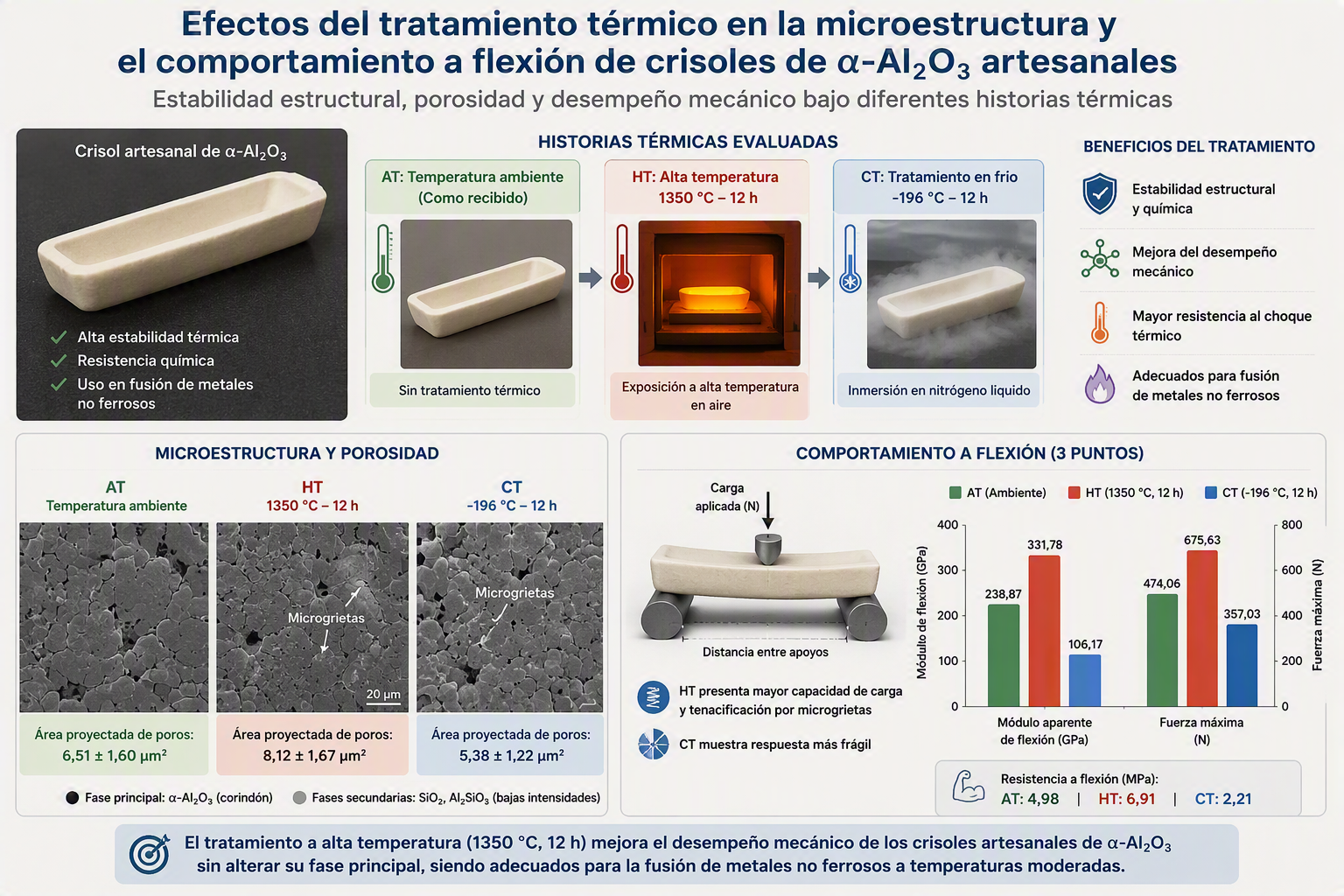
Los crisoles de alúmina son componentes cerámicos ampliamente utilizados en ciencia e ingeniería de materiales debido a su alta estabilidad térmica y su idoneidad para procesos como la fusión y la síntesis en estado sólido. Este estudio presenta la caracterización estructural, morfológica y mecánica de crisoles de alúmina elaborados artesanalmente y obtenidos de un proveedor comercial en Bogotá, Colombia, evaluados después de tres historias térmicas diferentes: recibidos a temperatura ambiente (AT), exposición a alta temperatura a 1350 °C durante 12 horas (HT) y tratamiento en frío mediante inmersión en nitrógeno líquido a -196 °C (CT). La difracción de rayos X identificó la α-Al₂O₃ (corindón) como la fase cristalina predominante en todas las condiciones, junto con señales secundarias menores asociadas a SiO₂ y Al₂SiO₂. No se detectaron transformaciones de fase después de ninguno de los tratamientos, lo que confirma la elevada estabilidad estructural y química del material. El análisis de las superficies de fractura reveló que las muestras HT presentaron la mayor área proyectada de poros (8,12 ± 1,67 µm²) en comparación con AT (6,51 ± 1,60 µm²) y CT (5,38 ± 1,22 µm²), acompañada por una red distribuida de microgrietas a escala de grano. Los ensayos mecánicos indicaron que los crisoles HT alcanzaron el mayor módulo aparente de flexión (331,78 GPa) y la mayor capacidad de carga, superando a AT (238,87 GPa) y CT (106,17 GPa). Este comportamiento se atribuyó a un mecanismo de tenacificación por microgrietas, mientras que las muestras CT mostraron una respuesta más frágil. El comportamiento mecánico estuvo gobernado principalmente por la arquitectura de defectos más que por cambios composicionales, y los crisoles demostraron niveles de desempeño compatibles con la fusión de metales no ferrosos a temperaturas moderadas.Referencias
Alimdjanova, D. I., Babakhanova, Z. A., Ayupov, U. M., Nusretov, R. A., & Kurniawan, T. A. (2025). Fireclay crucibles with improved properties for assaying ores. Glass and Ceramics, 82, 171–176. https://doi.org/10.1007/s10717-025-00767-5
Asmani, M., Kermel, C., Leriche, A., & Ourak, M. (n.d.). Influence of porosity on Young’s modulus and Poisson’s ratio in alumina ceramics. Journal of the European Ceramic Society, 21(8), 1081–1086.
Barry, K., Sawadogo, Y., Sawadogo, M., Sorgho, B., Seynou, M., Guel, B., Blanchart, P., & Zerbo, L. (2024). Manufacture of industrial refractory crucibles based on clays from Burkina Faso. Journal of Minerals and Materials Characterization and Engineering, 12, 79–90. https://doi.org/10.4236/jmmce.2024.122006
Barros, M., Jelitto, H., Hotza, D., & Janssen, R. (2021). Microstructure and mechanical behavior of TiO₂-MnO-doped alumina/alumina laminates. Journal of the American Ceramic Society, 104(3), 1047–1057. https://doi.org/10.1111/jace.17490
Brahmadathan, V. B., & Lakshmana, R. C. (2024). Development of micromechanical constitutive model for alumina at high strain rates using unified mechanics theory. Procedia Structural Integrity, 60, 214–221. https://doi.org/10.1016/j.prostr.2024.05.043
Evans, A. G., & Faber, K. T. (1984). Crack-growth resistance of microcracking brittle materials. Journal of the American Ceramic Society, 67, 255–260. https://doi.org/10.1111/j.1151-2916.1984.tb18842.x
Fan, J., Fan, H., Song, Z., Guo, Y., Li, M., Li, X., Qi, C., & Xu, X. (2023a). Thermal-shock stable Al₂O₃ crucible for superalloy smelting through slip casting with particle gradation. Ceramics International, 49, 8762–8771. https://doi.org/10.1016/j.ceramint.2022.11.022
Fan, K., Jiang, W., Ruiz-Hervias, J., Baudín, C., Feng, W., Zhou, H., Bueno, S., & Yao, P. (2021). Effect of Al₂TiO₅ content and sintering temperature on the microstructure and residual stress of Al₂O₃-Al₂TiO₅ ceramic composites. Materials, 14(24), 7624. https://doi.org/10.3390/ma14247624
Guo, F., He, Z., Liu, L., Li, J., & Huang, Y. (2022). High-strength and corrosion-resistant Al₂O₃ ceramics with excellent closed-cell structure. Ceramics International, 48(23), 33160–33166. https://doi.org/10.1016/j.ceramint.2022.07.253
Hattali, M. L., Valette, S., Ropital, F., Mesrati, N., & Tréheux, D. (2010). Calculation and experimental determinations of the residual stress distribution in alumina/Ni/alumina and alumina/Ni/nickel alloy systems. Journal of Materials Science, 45(15), 4133–4140. https://doi.org/10.1007/s10853-010-4502-8
Ikesue, A., & Aung, Y. L. (2023). Anisotropic alumina ceramics with isotropic optical properties. Journal of Advanced Ceramics, 12(1), 72–81. https://doi.org/10.26599/JAC.2023.9220667
Jia, X., Cao, X., Cheng, X., Zhang, Z., Wang, Q., Zhou, J., & Li, W. (2026). Strain rate-dependent indentation responses and microstructural evolution mechanisms of aluminum oxynitride ceramics. Journal of the American Ceramic Society, 109, e70470. https://doi.org/10.1111/jace.70470
Khan, S. A., Mohd Zain, Z., Siddiqui, Z., Khan, W., Aabid, A., Baig, M., & Abdul Malik, M. (2024). Development of magnesium aluminate (MgAl₂O₄) nanoparticles for refractory crucible application. PLoS ONE, 19(1), e0296793. https://doi.org/10.1371/journal.pone.0296793
Luo, L., Zhang, T., Zhang, X., Yun, R., Lin, Y., Zhang, B., & Xiang, X. (2020). Enhanced hydrogen production from ethanol photoreforming by site-specific deposition of Au on Cu₂O/TiO₂ p-n junction. Catalysts, 10(5), 539. https://doi.org/10.3390/catal10050539
Maiti, P., Sadhukhan, D., Ghosh, J., & Mukhopadhyay, A. K. (2022). Nanoscale plasticity in titania densified alumina ceramics. Journal of Applied Physics, 131(13), 135107. https://doi.org/10.1063/5.0081872
Makireddi, D., Ghuge, V. D., Thakare, G., & Thawre, M. M. (2020). Application of two-step sintering cycle to 20–30 nm α-Al₂O₃ compacts to investigate microstructure, hardness, strength, density and corundum formation. Materials Research Express, 6(12), 1250e1. https://doi.org/10.1088/2053-1591/ab653b
Munro, R. G. (1997). Evaluated material properties for a sintered alpha-alumina. Journal of the American Ceramic Society, 80(8), 1919–1928. https://doi.org/10.1111/j.1151-2916.1997.tb03074.x
Musket, R. G., & Strausser, Y. E. (1980). Detection of monolayer quantities of oxygen on silicon using energy-dispersive X-ray spectrometry. Applied Physics Letters, 37(5), 478–480. https://doi.org/10.1063/1.91737
Nakajima, D., Kikuchi, T., Yoshioka, T., Matsushima, H., Ueda, M., Suzuki, R. O., & Natsui, S. (2019). A superhydrophilic aluminum surface with fast water evaporation based on anodic alumina bundle structures via anodizing in pyrophosphoric acid. Materials, 12(21), 3497. https://doi.org/10.3390/ma12213497
Nigay, P. M., Cutard, T., & Nzihou, A. (2017). The impact of heat treatment on the microstructure of a clay ceramic and its thermal and mechanical properties. Ceramics International, 43(2), 1747–1754. https://doi.org/10.1016/j.ceramint.2016.10.084
Nwankwo, E. I., Onyegirim, S. N. K., Owuama, K. C., & Ubani, C. A. (n.d.). Engineering crucible pots: A review of kaolin-based composites with functional additives. International Journal of Applied and Natural Sciences, 3(2), 50–62.
Rietveld, H. M. (2014). The Rietveld method. Physica Scripta, 89(2), 098002. https://doi.org/10.1088/0031-8949/89/9/098002
Schneider, C. A., Rasband, W. S., & Eliceiri, K. W. (2012). NIH Image to ImageJ: 25 years of image analysis. Nature Methods, 9(7), 671–675. https://doi.org/10.1038/nmeth.2089
Shakirzyanov, R., Maznykh, S., Garanin, Y., & Kaliyekperov, M. (2025). Compositional effects on mechanical performance of zirconia-magnesia-alumina ceramics. Ceramics, 8(3), 114.
Sun, Z., Lin, H., Zhang, L., Cai, X., Feng, T., Zhang, J., & Yang, X. (2024). Investigation of phase and microstructural transformations in different alumina-silica fibers at varied heat treatment temperatures: Exploring the mechanism of silica’s influence. Ceramics International, 50(21), 39406–39421. https://doi.org/10.1016/j.ceramint.2024.07.315