
Keywords
Coffee
Agribusiness
PLC
Rural innovation
How to Cite
Abstract
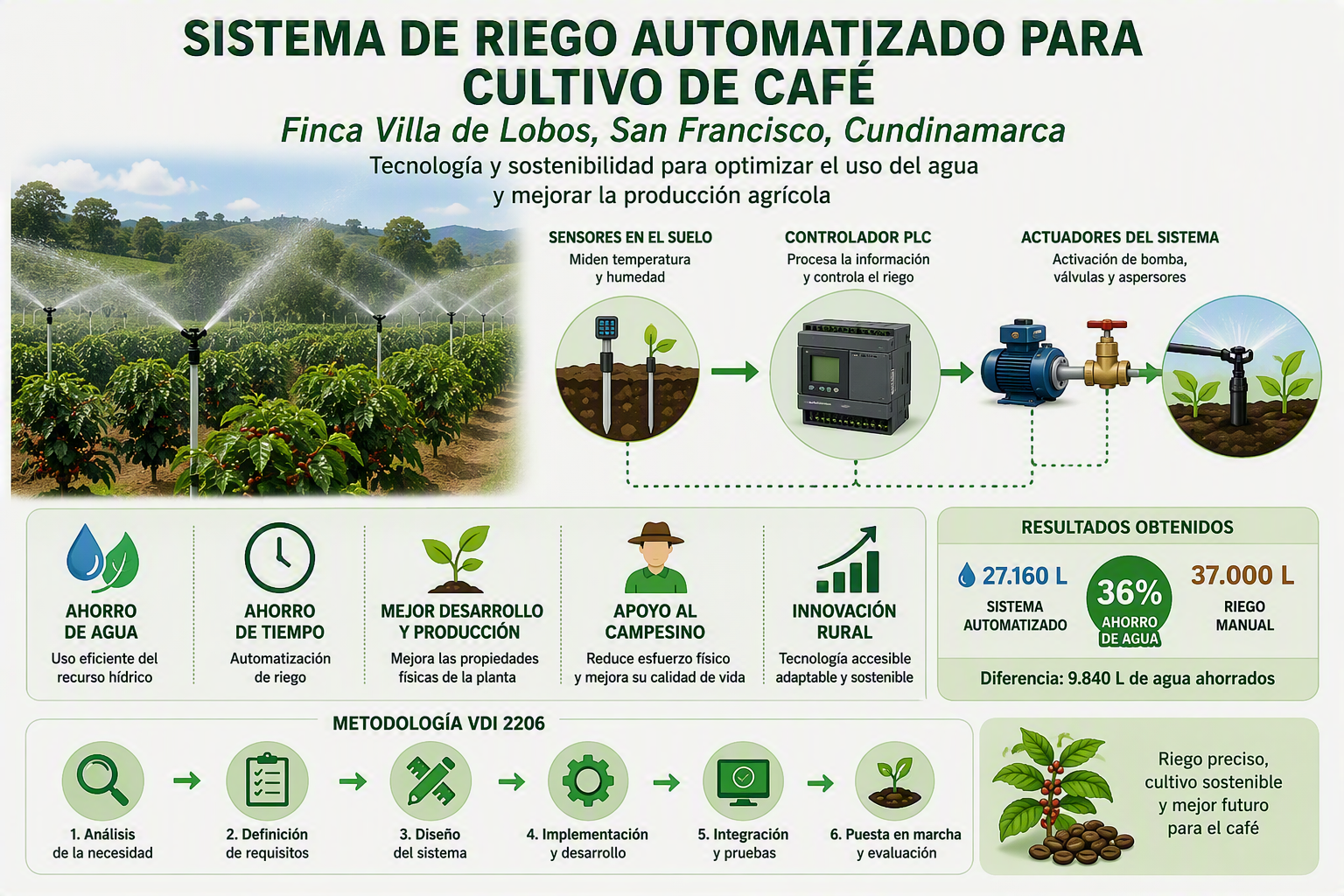
This study was conducted under the guidelines of the Fundación Universitaria Agraria de Colombia, which prioritizes research aimed at creating, developing, systematizing, applying, and disseminating knowledge for economic and social progress with a territorial focus. The project focused on applying technology in the agricultural sector to generate sustainable alternatives and support farmers in their daily activities. It was carried out at Villa de Lobos Farm, in San Francisco, Cundinamarca, where manual irrigation during dry seasons had become increasingly difficult and detrimental to the farmer’s health. In response to this issue and the absence of proper irrigation control for coffee crops in the region, an automated sprinkler irrigation system was developed and implemented. This system uses soil temperature and humidity sensors, whose data are processed by a PLC, which controls irrigation automatically or manually based on the user’s needs. The system was designed using the VDI 2206 methodology, a flexible procedure model for mechatronic system design. This approach enabled the implementation of technologies that save time and water, especially during periods of drought, while improving the physical conditions of the plants and preventing delays in crop development. The project proved to be technically effective and economically feasible, with low implementation costs and adaptability to various crop types. The system successfully delivered precise water quantities to the coffee plantation and promoted sustainable practices that optimize water use, generate social impact, and enhance agricultural production techniques.References
Agrofer. (2022). Aspersor Plastico Sectorizado 1/2”. AGROFER AL S.A.S. https://repositoriotec.tec.ac.cr/handle/2238/9879
Organización de las Naciones Unidas para la Alimentación y la Agricultura [FAO]. (1999). Educación Ambiental para el Trópico de Cochabamba. FAO. https://www.fao.org/3/ah645s/AH645S00.htm
Organización de las Naciones Unidas para la Alimentación y la Agricultura [FAO]. (2005). Optimización de la humedad del suelo para la producción vegetal. Boletín de Suelos de la FAO, 79, 1-113.
NASA. (2022). Power Data Access Viewer. NASA. https://power.larc.nasa.gov/data-access-viewer/
Rendón Sáenz, J. y Giraldo Herrera, A. (2019). Distribución de raíces en café variedad Castillo® bajo dos arreglos espaciales. Revista Cenicafé, 70(1), 7-17. https://orcid.org/0000-0002-5676-4670