
Keywords
Osmotic dehydration
Microwave drying
Food valorization
Bakery products
How to Cite
Abstract
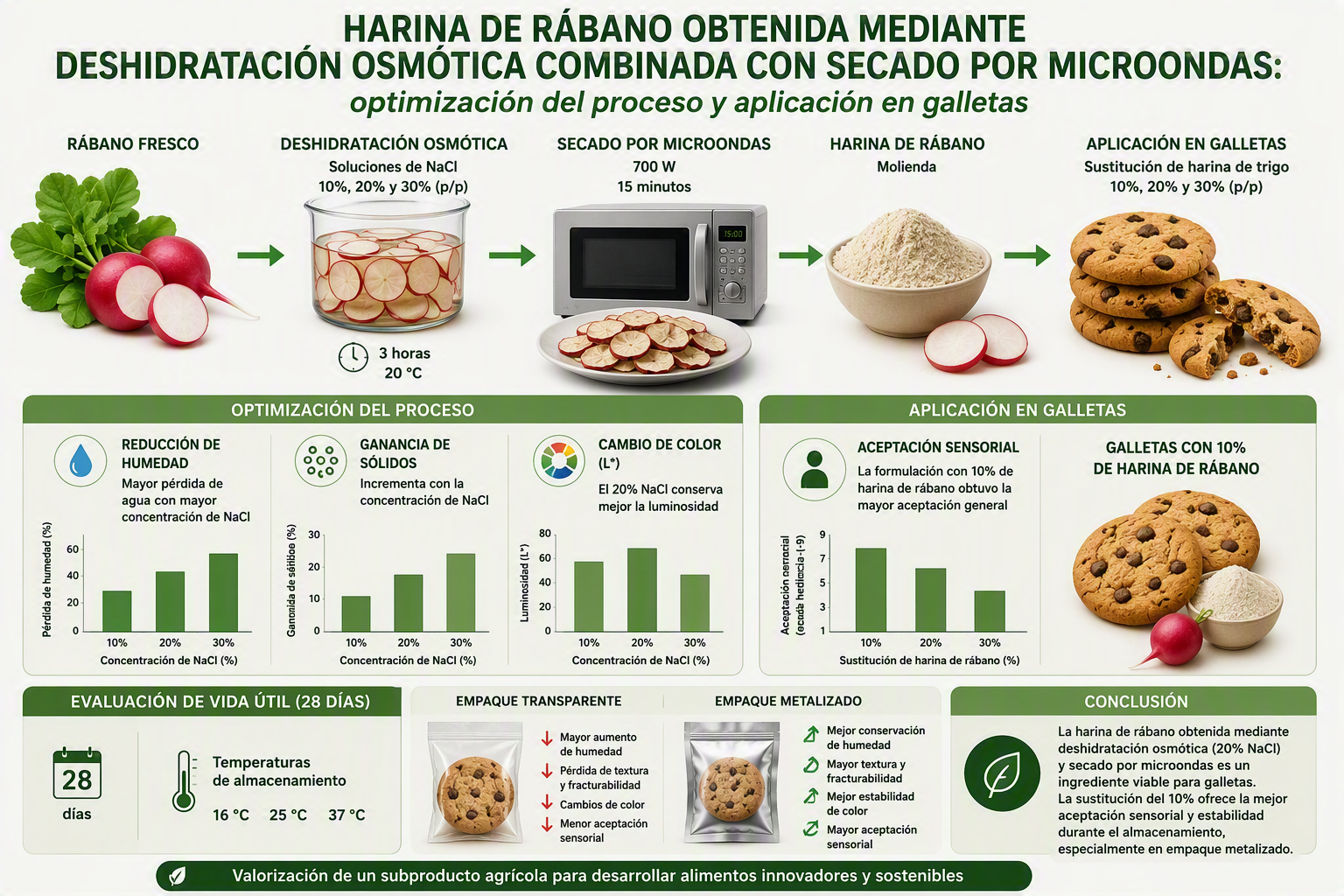
Radish production in Colombia has increased in recent years; however, its use remains limited to fresh consumption, leading to significant postharvest losses. This study evaluated the optimization of radish flour production through combined osmotic dehydration and microwave drying and its application in cookie formulation. Radish slices were osmotically dehydrated using sodium chloride solutions (10, 20, and 30% w/w) and subsequently dried by microwave radiation. Mass transfer kinetics, color changes, and sensory acceptance were analyzed. The 20% NaCl treatment showed the most balanced performance in terms of moisture reduction, solid gain, and color preservation. Radish flour was incorporated into cookies at substitution levels of 10, 20, and 30%, with the 10% formulation achieving the highest level of sensory acceptance. Shelf-life evaluation demonstrated superior stability in metallized packaging compared to transparent packaging. These results support radish flour as a viable ingredient for sustainable bakery applications.References
Azoubel, P. M., & Murr, F. E. X. (2004). Mass transfer kinetics of osmotic dehydration of cherry tomato. Journal of Food Engineering, 61(3), 291–295. https://doi.org/10.1016/S0260-8774(03)00132-8
Della, R. F., Serio, A., & de Figueirêdo, R. M. F. (2010). Influence of osmotic dehydration and microwave drying on quality attributes of fruits and vegetables. Food and Bioproducts Processing, 88(2–3), 133–141.
ASOHOFRUCOL. (2020). Plan Hortícola Nacional y diagnóstico del sector hortofrutícola en Colombia. Bogotá, Colombia.
FENALCE. (2019). Panorama productivo y agroindustrial del sector agrícola colombiano. Bogotá, Colombia.
Rahman, M. S. (2003). Handbook of food preservation. New York: Marcel Dekker.
Rastogi, N. K., Raghavarao, K. S. M. S., Niranjan, K., & Knorr, D. (2000). Recent developments in osmotic dehydration: methods to enhance mass transfer. Trends in Food Science & Technology, 11(2), 48–59.
Scaman, C. H. (2005). Microwave processing of foods. In D. R. Heldman & D. B. Lund (Eds.), Handbook of food engineering (2nd ed., pp. 599–632). Boca Raton: CRC Press.