Keywords
jar tests
rural water treatment
hydraulic modeling
sustainability
How to Cite
Abstract
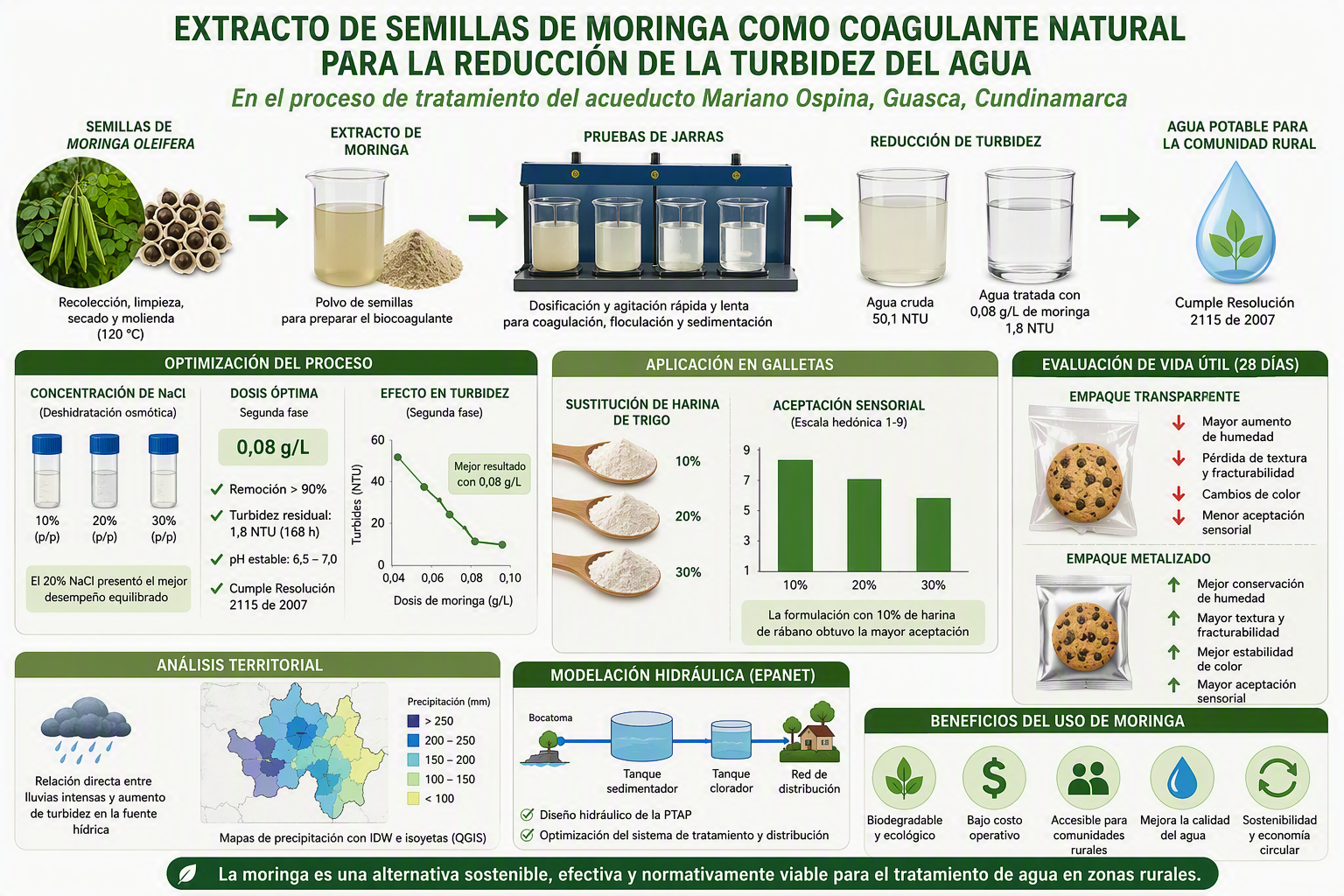
The study conducted in Guasca (Cundinamarca) evaluated the use of Moringa oleifera seed extract as a natural coagulant to improve water treatment at the Mariano Ospina community water system. Jug tests determined a preliminary optimal dose of 0.05 g/L, and after adjusting agitation and settling conditions, a residual turbidity of 1.8 NTU was achieved at 0.08 g/L within 168 hours, in compliance with Resolution 2115 of 2007. GIS analysis revealed a direct relationship between heavy rainfall and increased turbidity in the water source. Additionally, social, economic, and environmental benefits of using moringa were identified in rural communities without access to conventional technologies. Finally, the hydraulic design of the Drinking Water Treatment Plant (DWTP) was proposed using the Environmental Protection Agency Network (EPANET) as a technical input, confirming that moringa is an ecological, accessible, and regulatory-compliant alternative for water management in rural areas with high climatic variability.References
Liñán, C. M. (2010). La Moringa, el árbol milagroso. Centro de Agricultura Tropical.
Ministerio de la Protección Social y Ministerio de Ambiente, Vivienda y Desarrollo Territorial. (4 de julio de 2007). Resolución 2115 de 2007. Por medio de la cual se señalan características, instrumentos básicos y frecuencias del sistema de control y vigilancia para la calidad del agua para consumo humano. https://minvivienda.gov.co/sites/default/files/normativa/2115%20-%202007.pdf
Ministerio de Salud y Protección Social y Ministerio de Vivienda, Ciudad y Territorio. (20 de abril de 2020). Resolución 0622 de 2020. Por la cual se adopta el protocolo de inspección, vigilancia y control de la calidad del agua para consumo humano suministrada por personas prestadoras del servicio público domiciliario de acueducto en zona rural, y se dictan otras disposiciones. https://www.minsalud.gov.co/sites/rid/Lists/BibliotecaDigital/RIDE/VS/PP/SA/resolucion-622-de-2020.pdf
Parrotta, J. A. (1993). Moringa oleifera Lam.: Reseda, horseradish tree, benzolive tree. USDA Forest Service.
Sánchez-Peña, R. S. y Martínez-Ávila, J. (2013). Evaluación del uso de la semilla de Moringa oleifera en el tratamiento de aguas turbias. Revista Colombiana de Química, 42(1), 41–49