
Keywords
Encapsulation techniques
Bioactive compounds
Animal feed technology
Nutrient delivery systems
How to Cite
Abstract
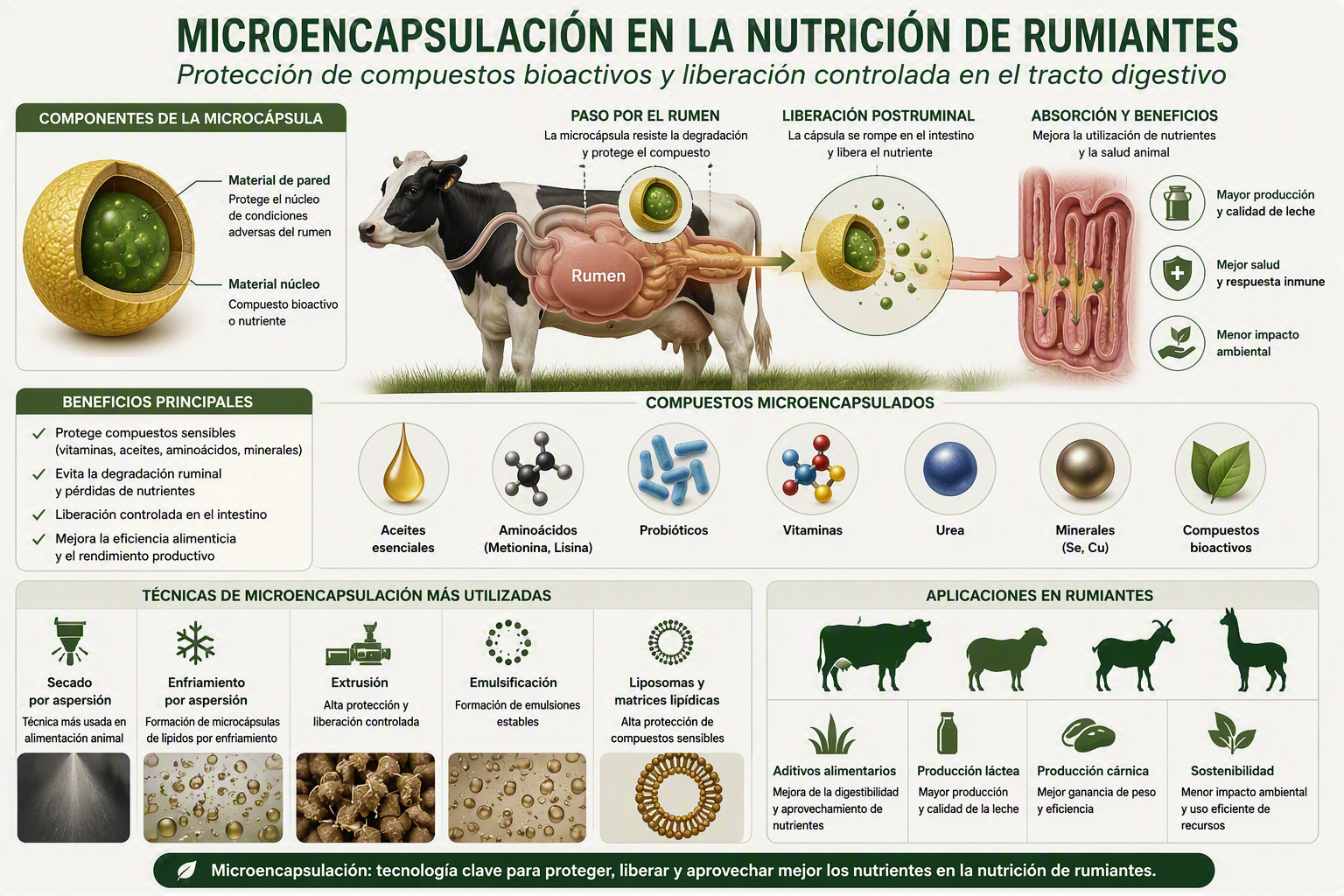
This article aims to present the process of making microcapsules and its benefits within animal nutrition, more specifically for ruminants. The review was carried out through a study of the literature regarding the nutrition of ruminants and the elaboration of microcapsules in order to choose the appropriate procedure that meets the desired purpose. A spreadsheet was elaborated to allow us to gather and summarize all the information found relating to authors, processes, materials, and techniques to later analyze those that were more effective. Following this, the writing of the article began considering the information found that allowed us to recognize the application of different specific methods used in the animal nutrition industry, among which spray drying and spray cooling stand out as successful techniques in the field of encapsulation of compounds of interest to implement improvements in the nutrition of ruminants.References
Adejoro, F. A., Hassen, A., & Thantsha, M. S. (2019). Characterization of starch and gum Arabic-maltodextrin microparticles encapsulating acacia tannin extract and evaluation of their potential use in ruminant nutrition. Asian-Australasian Journal of Animal Sciences, 32(7), 977–987. https://doi.org/10.5713/ajas.18.0632
Albuquerque, J., Casal, S., Páscoa, R. N. M. de J., Van Dorpe, I., Fonseca, A. J. M., Cabrita, A. R. J., Neves, A. R., & Reis, S. (2020). Applying nanotechnology to increase the rumen protection of amino acids in dairy cows. Scientific Reports, 10(1), 1–12. https://doi.org/10.1038/s41598-020-63793-z
Arce-Cordero, J. A., Monteiro, H. F., Lelis, A. L., Lima, L. R., Restelatto, R., Brandao, V. L. N., Leclerc, H., Vyas, D., & Faciola, A. P. (2020). Copper sulfate and sodium selenite lipid-microencapsulation modifies ruminal microbial fermentation in a dual-flow continuous-culture system. Journal of Dairy Science, 103(8), 7068–7080. https://doi.org/10.3168/jds.2019-17913
Arjona, J. de C., Silva-Valenzuela, M. D. G., Wang, S. H., & Valenzuela-Diaz, F. R. (2021). Biodegradable nanocomposite microcapsules for controlled release of urea. Polymers, 13(5), 1–12. https://doi.org/10.3390/polym13050722
Campos, A. C., Silva, A. L., Silva, A. M. A., Araujo Filho, J. M., Costa, T., Pereira Filho, J. M., Oliveira, J. P. F., & Bezerra, L. R. (2021). Dietary replacement of soybean meal with lipid matrix-encapsulated urea does not modify milk production and composition in dairy goats. Animal Feed Science and Technology, 274, 114763. https://doi.org/10.1016/j.anifeedsci.2020.114763
Contreras-Pacheco, Y. V., Gerardo, V. E., Jorge Alberto, S. B., Ghotekar, S., Fellah, M., & Pérez Larios, A. (2026). Natural sources of bioactive compounds: recent advances in isolation, functionalization, and health benefits. Food Research International, 223. https://doi.org/10.1016/j.foodres.2025.117853
Da Silva, R. B., Pereira, M. N., De Araujo, R. C., De Rezende Silva, W., & Pereira, R. A. N. (2020). A blend of essential oils improved feed efficiency and affected ruminal and systemic variables of dairy cows. Translational Animal Science, 4(1), 182–193. https://doi.org/10.1093/TAS/TXZ183
de B. Carvalho, A., da Silva, A. L., de A. Silva, A. M., Netto, A. J., de Medeiros, T. T. B., Araújo Filho, J. M., da S. Agostini, D. L., de Oliveira, D. L. V., Mazzetto, S. E., Kotzebue, L. R. V., Oliveira, J. R., Oliveira, R. L., & Bezerra, L. R. (2019). Effect of slow-release urea microencapsulated in beeswax and its inclusion in ruminant diets. Small Ruminant Research, 179, 56–63. https://doi.org/10.1016/j.smallrumres.2019.09.005
Dias Batista, L. F., Norris, A. B., & Tedeschi, L. O. (2020). Effects of salts of branched-chain volatile fatty acids protected with different combinations of encapsulation materials on gas production dynamics when incubated in vitro with Brachiaria brizantha ‘Marandu.’ Applied Animal Science, 36(5), 677–687. https://doi.org/10.15232/aas.2020-02017
Haque, M. N. (2018). Dietary manipulation: a sustainable way to mitigate methane emissions from ruminants. Journal of Animal Science and Technology, 60(1), 15. https://doi.org/10.1186/s40781-018-0175-7
Hoyos-Leyva, J. D., Bello-Pérez, L. A., Alvarez-Ramirez, J., & Garcia, H. S. (2018). Microencapsulation using starch as wall material: A review. Food Reviews International, 34(2), 148–161.
King, L., Wickramasinghe, J., Dooley, B., McCarthy, C., Branstad, E., Grilli, E., Baumgard, L., & Appuhamy, R. (2021). Effects of microencapsulated methionine on milk production and manure nitrogen excretions of lactating dairy cows. Animals, 11(12), 3545. https://doi.org/10.3390/ani11123545
Kiran, & Deswal, S. (2020). Role of feed additives in ruminant’s production: A review. The Pharma Innovation Journal, 9(2), 394–397.
Li, X. P., Tan, Z. L., Jiao, J. Z., Long, D. L., Zhou, C. S., Yi, K. L., Liu, C. H., Kang, J. H., Wang, M., Duan, F. H., Tang, S. X., He, Z. X., & Han, X. F. (2019). Supplementation with fat-coated rumen-protected glucose during the transition period enhances milk production and influences blood biochemical parameters of liver function and inflammation in dairy cows. Animal Feed Science and Technology, 252, 92–102. https://doi.org/10.1016/j.anifeedsci.2019.04.010
Macías-Cortés, E., Gallegos-Infante, J. A., Rocha-Guzmán, N. E., Moreno-Jiménez, M. R., Medina-Torres, L., & González-Laredo, R. F. (2020). Microencapsulation of phenolic compounds: Technologies and novel polymers. Revista Mexicana de Ingeniería Química, 19(2), 491–521. https://doi.org/10.24275/rmiq/Alim642
Marcillo-Parra, V., Tupuna-Yerovi, D. S., González, Z., & Ruales, J. (2021). Encapsulation of bioactive compounds from fruit and vegetable by-products for food application: A review. Trends in Food Science and Technology, 116, 11–23. https://doi.org/10.1016/j.tifs.2021.07.009
Melo, M., da Silva, A., Silva Filho, E., Oliveira, R., Silva Junior, J., Oliveira, J. P., Vaz, A., Moura, J., Pereira Filho, J., & Bezerra, L. (2021). Polymeric microparticles of calcium pectinate containing urea for slow release in ruminant diet. Polymers, 13(21), 3776. https://doi.org/10.3390/polym13213776
Mizrahi, I., Wallace, R. J., & Moraïs, S. (2021). The rumen microbiome: balancing food security and environmental impacts. Nature Reviews Microbiology, 19(9), 553–566. https://doi.org/10.1038/s41579-021-00543-6
Moschona, A., & Liakopoulou-Kyriakides, M. (2018). Encapsulation of biological active phenolic compounds extracted from wine wastes in alginate-chitosan microbeads. Journal of Microencapsulation, 35(3), 229–240. https://doi.org/10.1080/02652048.2018.1462415
Öztürk, H., & Gür, G. (2021). Rumen physiology: Microorganisms, fermentation and manipulation. Ankara Universitesi Veteriner Fakultesi Dergisi, 68(4), 423–434. https://doi.org/10.33988/auvfd.960447
Park, J. H., Kumar, G., Yun, Y. M., Kwon, J. C., & Kim, S. H. (2018). Effect of feeding mode and dilution on the performance and microbial community population in anaerobic digestion of food waste. Bioresource Technology, 248, 134–140. https://doi.org/10.1016/j.biortech.2017.07.025
Tan, P., Liu, H., Zhao, J., Gu, X., Wei, X., Zhang, X., Ma, N., Johnston, L. J., Bai, Y., Zhang, W., Nie, C., & Ma, X. (2021). Amino acids metabolism by rumen microorganisms: Nutrition and ecology strategies to reduce nitrogen emissions from the inside to the outside. Science of the Total Environment, 800, 149596. https://doi.org/10.1016/j.scitotenv.2021.149596
Thies, C. (2012). Microencapsulation methods based on biopolymer phase separation and gelation phenomena in aqueous media. En N. Garti & D. J. McClements (Eds.), Encapsulation Technologies and Delivery Systems for Food Ingredients and Nutraceuticals (pp. 177–207). Woodhead Publishing. https://doi.org/10.1533/9780857095909.2.177
Tolve, R., Tchuenbou-Magaia, F., Di Cairano, M., Caruso, M. C., Scarpa, T., & Galgano, F. (2021). Encapsulation of bioactive compounds for the formulation of functional animal feeds: The biofortification of derivate foods. Animal Feed Science and Technology, 279, 115036. https://doi.org/10.1016/j.anifeedsci.2021.115036
Wang, Y., Lu, Z., Lv, F., & Bie, X. (2009). Study on microencapsulation of curcumin pigments by spray drying. European Food Research and Technology, 229(3), 391–396. https://doi.org/10.1007/s00217-009-1064-6
Wu, Y., Mou, B., Song, S., Tan, C. P., Lai, O. M., Shen, C., & Cheong, L. Z. (2020). Curcumin-loaded liposomes prepared from bovine milk and krill phospholipids: Effects of chemical composition on storage stability, in-vitro digestibility and anti-hyperglycemic properties. Food Research International, 136, 109301. https://doi.org/10.1016/j.foodres.2020.109301
Zanoni, F., Primiterra, M., Angeli, N., & Zoccatelli, G. (2020). Microencapsulation by spray-drying of polyphenols extracted from red chicory and red cabbage: Effects on stability and color properties. Food Chemistry, 307, 125535. https://doi.org/10.1016/j.foodchem.2019.125535