
Keywords
weight loss
membrane integrity
exportation storage
How to Cite
Abstract
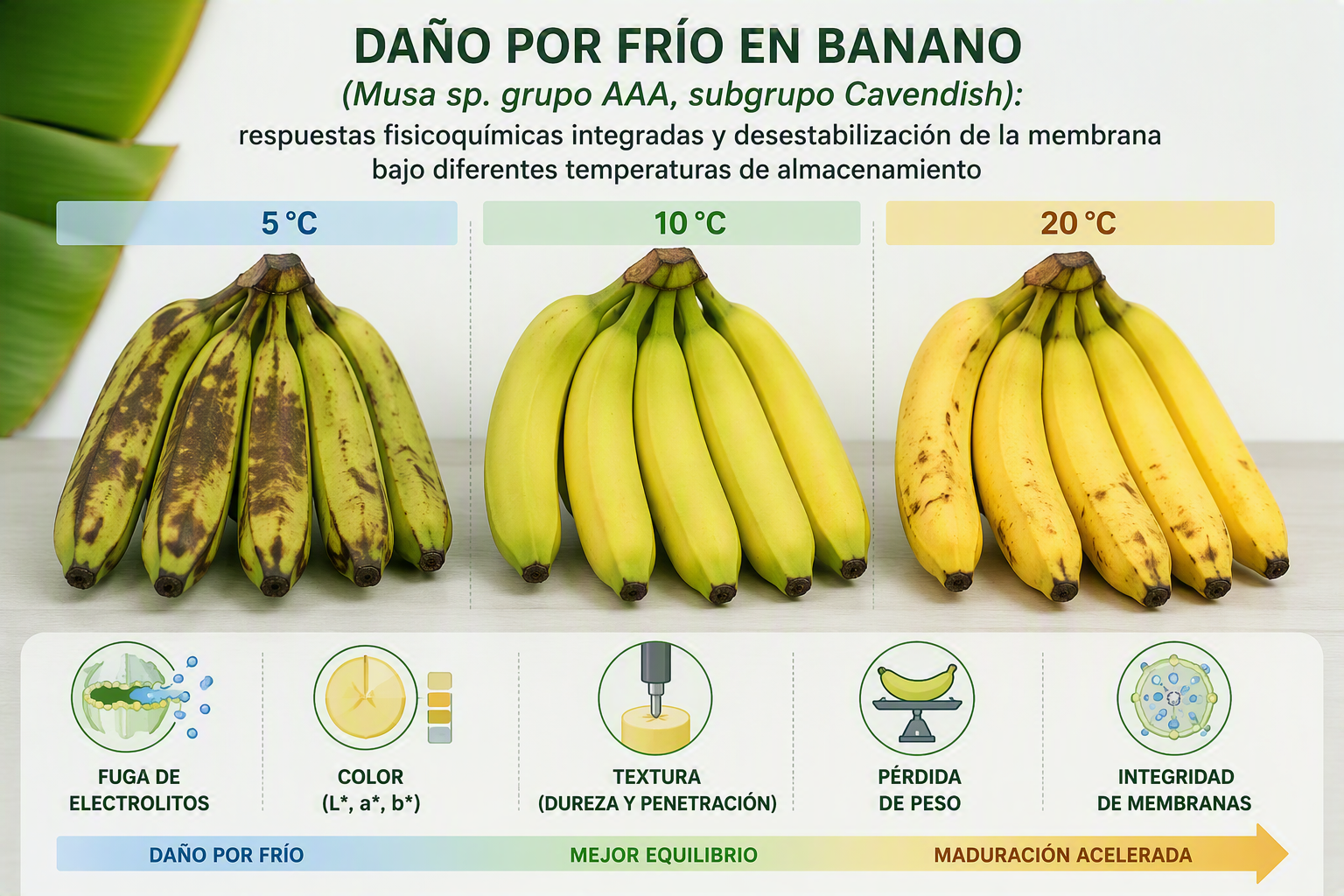
The postharvest quality of banana is strongly influenced by storage temperature and time, which together regulate physiological, biochemical, and structural changes in the fruit. This study evaluated the effects of storage at 5, 10, and 20°C, as well as temperature transfer conditions, on key quality parameters including color (L*, a*, b*), electrolyte leakage, texture (firmness and penetration), and weight loss over 21 days. Results showed that storage at 5°C induced chilling injury, characterized by increased electrolyte leakage, peel browning, reduced luminosity (L*), impaired yellow color development (b*), and abnormal softening associated with cellular damage rather than normal ripening. In contrast, fruits stored at 20°C exhibited rapid and coordinated ripening, with increased respiration, greater weight loss, and progressive softening. Storage at 10°C maintained a better balance, reducing metabolic activity while preserving membrane integrity, color development, and texture. Temperature transfers revealed that prior exposure to low temperatures triggers irreversible physiological damage that becomes evident under ambient conditions. Overall, the findings highlight the importance of optimizing storage temperature to maintain fruit quality and reduce postharvest losses in banana supply chains.References
Cordenunsi-Lysenko, B. R., Nascimento, J. R. O., Castro-Alves, V. C., Purgatto, E., Fabi, J. P., y Peroni-Okyta, F. H. G. (2019). The starch is (not) just another brick in the wall: The primary metabolism of sugars during banana ripening. Frontiers in Plant Science, 10, 452915. https://doi.org/10.3389/fpls.2019.00391
Der Agopian, R. G., Peroni-Okita, F. H. G., Soares, C. A., Mainardi, J. A., Do Nascimento, J. R. O., Cordenunsi, B. R., Lajolo, F. M., y Purgatto, E. (2011). Low temperature induced changes in activity and protein levels of the enzymes associated to conversion of starch to sucrose in banana fruit. Postharvest Biology and Technology, 62(2), 133–140. https://doi.org/10.1016/j.postharvbio.2011.05.008
El-Hadidy, G. A., Mshraky, A. M., y Ali, E. Z. (2016). An Attempt to Prolong the Cold Storage of Green Banana Fruits using some Safe Treatments to Reduce the Chilling injury. Middle East Journal of Applied Sciences, 6(4), 833–841.
Fu, X., Cheng, S., Liao, Y., Huang, B., Du, B., Zeng, W., Jiang, Y., Duan, X., y Yang, Z. (2018). Comparative analysis of pigments in red and yellow banana fruit. Food Chemistry, 239, 1009–1018. https://doi.org/10.1016/j.foodchem.2017.07.046
He, W. Di, Gao, J., Dou, T. X., Shao, X. H., Bi, F. C., Sheng, O., Deng, G. M., Li, C. Y., Hu, C. H., Liu, J. H., Zhang, S., Yang, Q. S., y Yi, G. J. (2018). Early cold-induced peroxidases and aquaporins are associated with high cold tolerance in Dajiao (Musa spp. ‘Dajiao’). Frontiers in Plant Science, 9, 323137. https://doi.org/10.3389/fpls.2018.00282
Kaur, L., Dhull, S. B., Kumar, P., y Singh, A. (2020). Banana starch: Properties, description, and modified variations - A review. International Journal of Biological Macromolecules, 165(PB), 2096–2102. https://doi.org/10.1016/j.ijbiomac.2020.10.058
Li, D., Limwachiranon, J., Li, L., Du, R., y Luo, Z. (2016). Involvement of energy metabolism to chilling tolerance induced by hydrogen sulfide in cold-stored banana fruit. Food Chemistry, 208, 272–278. https://doi.org/10.1016/j.foodchem.2016.03.113
Liu, J., Li, Q., Chen, J., y Jiang, Y. (2020). Revealing further insights on chilling injury of postharvest bananas by untargeted lipidomics. Foods, 9(7). https://doi.org/10.3390/foods9070894
Lo’ay, A. A., Hamed, S. E., EL-Khateeb, A. Y., y Mohamed, A. H. (2020). Implementation exogenous ATP on the starch degradation enzyme activities of ‘Grand Nain’ banana fruit during shelf life. Scientia Horticulturae, 262, 109021. https://doi.org/10.1016/j.scienta.2019.109021
Lobo, M. G., y Rojas, F. J. F. (2020). Biology and postharvest physiology of banana. En Siddiq, M., Ahmed, J., Lobo, M. G. (Eds.), Handbook of Banana Production, Postharvest Science, Processing Technology, and Nutrition (pp. 19–44). John Wiley & Sons Ltd. https://doi.org/10.1002/9781119528265.ch2
Lufu, R., Ambaw, A., y Opara, U. L. (2019). The contribution of transpiration and respiration processes in the mass loss of pomegranate fruit (cv. Wonderful). Postharvest Biology and Technology, 157, 110982. https://doi.org/10.1016/j.postharvbio.2019.110982
Maduwanthi, S. D. T., y Marapana, R. A. U. J. (2019). Induced Ripening Agents and Their Effect on Fruit Quality of Banana. International Journal of Food Science, 2019(1), 2520179. https://doi.org/10.1155/2019/2520179
Minor, T., y von Horn, C. (2019). Rewarming Injury after Cold Preservation. International Journal of Molecular Sciences, 20(9), 2059. https://doi.org/10.3390/ijms20092059
Murmu, S. B., y Mishra, H. N. (2018). Postharvest shelf-life of banana and guava: Mechanisms of common degradation problems and emerging counteracting strategies. Innovative Food Science and Emerging Technologies, 49, 20–30. https://doi.org/10.1016/j.ifset.2018.07.011
Patel, B., Tandel, Y. N., Patel, A. H., y Patel, B. L. (2016). Chilling injury in tropical and subtropical fruits: a cold storage problem and its remedies: a review. International Journal of Science, Environment, 5(4), 1882–1887.
Pott, D. M., Vallarino, J. G., y Osorio, S. (2020). Metabolite Changes during Postharvest Storage: Effects on Fruit Quality Traits. Metabolites, 10(5), 187. https://doi.org/10.3390/metabo10050187
Prasad, K., Jacob, S., y Siddiqui, M. W. (2018). Fruit Maturity, Harvesting, and Quality Standards. Preharvest Modulation of Postharvest Fruit and Vegetable Quality, 41–69. https://doi.org/10.1016/B978-0-12-809807-3.00002-0
Ramírez-Sánchez, M., Huber, D. J., y Vallejos, C. E. (2018). Comparison of tissue deterioration of ripening banana fruit (Musa spp., AAA group, Cavendish subgroup) under chilling and nonchilling temperatures. Journal of the Science of Food and Agriculture, 98(12), 4644–4652. https://doi.org/10.1002/jsfa.8994
Sañudo-Barajas, A. A., Lipan, L., Cano-Lamadrid, M., Vélez de la Rocha, R., Noguera-Artiaga, L., Sánchez-Rodríguez, L., Carbonell-Barrachina, Á. A., y Hernández, F. (2019). Texture. Postharvest Physiology and Biochemistry of Fruits and Vegetables, 293–314. https://doi.org/10.1016/B978-0-12-813278-4.00014-2
Selvarajan, E., Veena, R., y Manoj Kumar, N. (2018). Polyphenol oxidase, beyond enzyme browning. En Singh, J., Sharma, D., Kumare, G., Sharma, N. R. (Ed.), Microbial Bioprospecting for Sustainable Development (pp. 203–222). Springer. https://doi.org/10.1007/978-981-13-0053-0_10
Sousa-Gallagher, M. J., Tank, A., y Sousa, R. (2016). Emerging Technologies to Extend the Shelf Life and Stability of Fruits and Vegetables. En Subramaniam, P. (Ed.), The Stability and Shelf Life of Food (pp. 399–430). Woodhead Publishing. https://doi.org/10.1016/B978-0-08-100435-7.00014-9
Sun, H. Jun, Luo, M. Li, Zhou, X., Zhou, Q., y Ji, S. Juan. (2020). Influence of Melatonin Treatment on Peel Browning of Cold-Stored “Nanguo” Pears. Food and Bioprocess Technology, 13(8), 1478–1490. https://doi.org/10.1007/s11947-020-02489-8
Valenzuela, J. L., Manzano, S., Palma, F., Carvajal, F., Garrido, D., y Jamilena, M. (2017). Oxidative Stress Associated with Chilling Injury in Immature Fruit: Postharvest Technological and Biotechnological Solutions. International Journal of Molecular Sciences, 18(7), 1467. https://doi.org/10.3390/ijms18071467
Zhang, C., Ding, Z., Xu, X., Wang, Q., Qin, G., y Tian, S. (2009). Crucial roles of membrane stability and its related proteins in the tolerance of peach fruit to chilling injury. Amino Acids, 39(1), 181–194. https://doi.org/10.1007/s00726-009-0397-6
Zhang, J., Cheng, D., Wang, B., Khan, I., y Ni, Y. (2017). Ethylene Control Technologies in Extending Postharvest Shelf Life of Climacteric Fruit. Journal of Agricultural and Food Chemistry, 65(34), 7308–7319. https://doi.org/10.1021/acs.jafc.7b02616
Zhu, X., Luo, J., Li, Q., Li, J., Liu, T., Wang, R., Chen, W., y Li, X. (2018). Low temperature storage reduces aroma-related volatiles production during shelf-life of banana fruit mainly by regulating key genes involved in volatile biosynthetic pathways. Postharvest Biology and Technology, 146, 68–78. https://doi.org/10.1016/j.postharvbio.2018.08.015