
Palabras clave
postcosecha de banano
integridad de membranas
almacenamiento para exportación
Cómo citar
Resumen
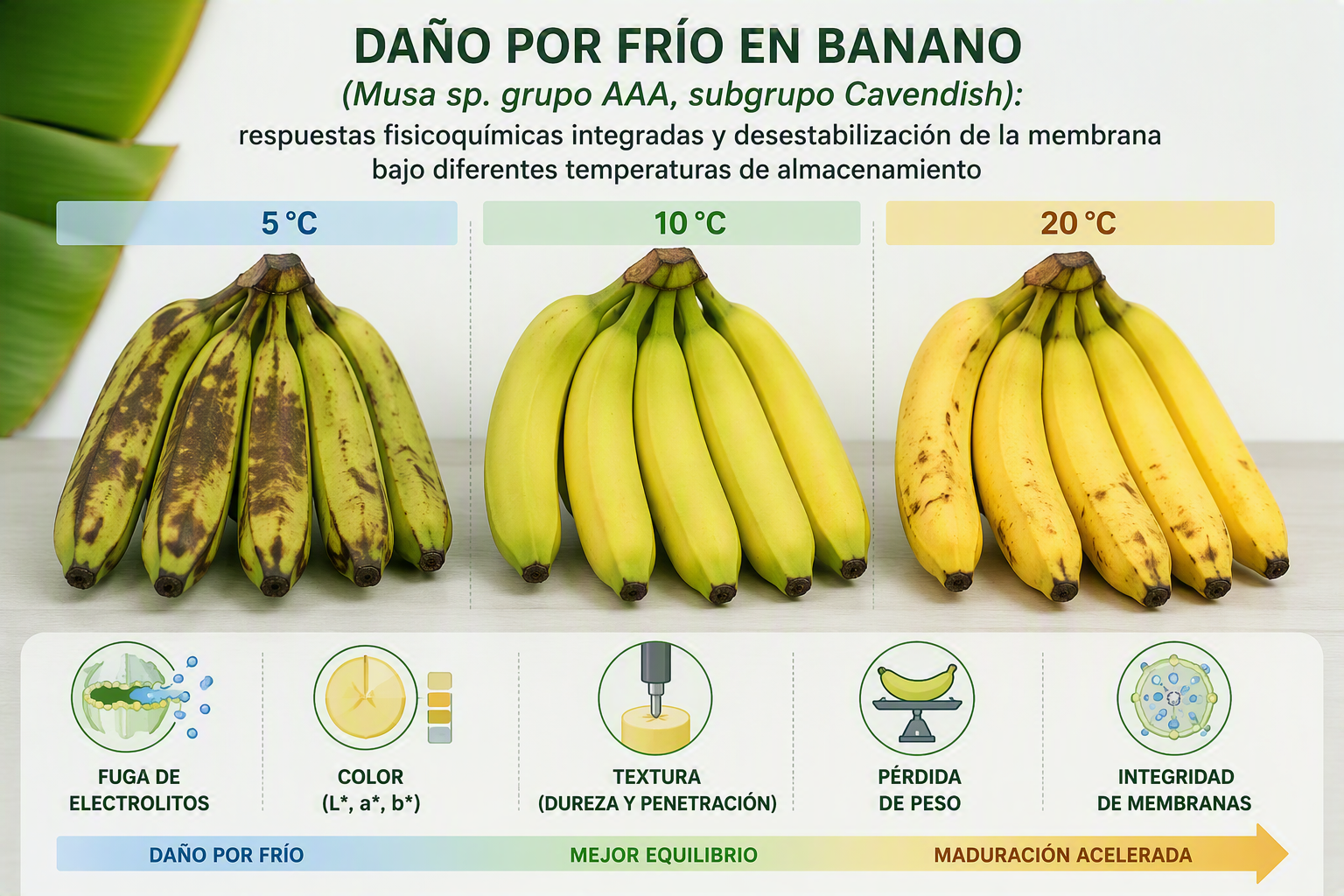
La calidad postcosecha del banano está fuertemente influenciada por la temperatura y el tiempo de almacenamiento, factores que regulan cambios fisiológicos, bioquímicos y estructurales del fruto. En este estudio se evaluó el efecto del almacenamiento a 5, 10 y 20 °C, así como de las condiciones en transferencia a temperatura ambiente, sobre parámetros clave de calidad como color (L*, a*, b*), pérdida de electrolitos, textura (dureza y penetración) y pérdida de peso durante 21 días. Los resultados mostraron que el almacenamiento a 5 °C induce daño por frío, evidenciado por un incremento en la fuga de electrolitos, el oscurecimiento de la cáscara, la disminución de la luminosidad (L*), alteraciones en el desarrollo del color amarillo (b*) y ablandamiento anómalo, asociado a daño celular más que a un proceso de maduración fisiológica. En contraste, los frutos almacenados a 20 °C presentaron una maduración acelerada y coordinada, con mayor pérdida de peso y cambios progresivos en textura. El almacenamiento a 10 °C permitió mantener un equilibrio entre la reducción de la actividad metabólica y la conservación de la integridad celular. Los tratamientos de transferencia evidenciaron que la exposición previa a bajas temperaturas genera daños irreversibles que se manifiestan al restablecer las condiciones ambientales. En conjunto, los resultados resaltan la importancia de optimizar la temperatura de almacenamiento para preservar la calidad del fruto y reducir pérdidas en la cadena de suministro.Referencias
Cordenunsi-Lysenko, B. R., Nascimento, J. R. O., Castro-Alves, V. C., Purgatto, E., Fabi, J. P., y Peroni-Okyta, F. H. G. (2019). The starch is (not) just another brick in the wall: The primary metabolism of sugars during banana ripening. Frontiers in Plant Science, 10, 452915. https://doi.org/10.3389/fpls.2019.00391
Der Agopian, R. G., Peroni-Okita, F. H. G., Soares, C. A., Mainardi, J. A., Do Nascimento, J. R. O., Cordenunsi, B. R., Lajolo, F. M., y Purgatto, E. (2011). Low temperature induced changes in activity and protein levels of the enzymes associated to conversion of starch to sucrose in banana fruit. Postharvest Biology and Technology, 62(2), 133–140. https://doi.org/10.1016/j.postharvbio.2011.05.008
El-Hadidy, G. A., Mshraky, A. M., y Ali, E. Z. (2016). An Attempt to Prolong the Cold Storage of Green Banana Fruits using some Safe Treatments to Reduce the Chilling injury. Middle East Journal of Applied Sciences, 6(4), 833–841.
Fu, X., Cheng, S., Liao, Y., Huang, B., Du, B., Zeng, W., Jiang, Y., Duan, X., y Yang, Z. (2018). Comparative analysis of pigments in red and yellow banana fruit. Food Chemistry, 239, 1009–1018. https://doi.org/10.1016/j.foodchem.2017.07.046
He, W. Di, Gao, J., Dou, T. X., Shao, X. H., Bi, F. C., Sheng, O., Deng, G. M., Li, C. Y., Hu, C. H., Liu, J. H., Zhang, S., Yang, Q. S., y Yi, G. J. (2018). Early cold-induced peroxidases and aquaporins are associated with high cold tolerance in Dajiao (Musa spp. ‘Dajiao’). Frontiers in Plant Science, 9, 323137. https://doi.org/10.3389/fpls.2018.00282
Kaur, L., Dhull, S. B., Kumar, P., y Singh, A. (2020). Banana starch: Properties, description, and modified variations - A review. International Journal of Biological Macromolecules, 165(PB), 2096–2102. https://doi.org/10.1016/j.ijbiomac.2020.10.058
Li, D., Limwachiranon, J., Li, L., Du, R., y Luo, Z. (2016). Involvement of energy metabolism to chilling tolerance induced by hydrogen sulfide in cold-stored banana fruit. Food Chemistry, 208, 272–278. https://doi.org/10.1016/j.foodchem.2016.03.113
Liu, J., Li, Q., Chen, J., y Jiang, Y. (2020). Revealing further insights on chilling injury of postharvest bananas by untargeted lipidomics. Foods, 9(7). https://doi.org/10.3390/foods9070894
Lo’ay, A. A., Hamed, S. E., EL-Khateeb, A. Y., y Mohamed, A. H. (2020). Implementation exogenous ATP on the starch degradation enzyme activities of ‘Grand Nain’ banana fruit during shelf life. Scientia Horticulturae, 262, 109021. https://doi.org/10.1016/j.scienta.2019.109021
Lobo, M. G., y Rojas, F. J. F. (2020). Biology and postharvest physiology of banana. En Siddiq, M., Ahmed, J., Lobo, M. G. (Eds.), Handbook of Banana Production, Postharvest Science, Processing Technology, and Nutrition (pp. 19–44). John Wiley & Sons Ltd. https://doi.org/10.1002/9781119528265.ch2
Lufu, R., Ambaw, A., y Opara, U. L. (2019). The contribution of transpiration and respiration processes in the mass loss of pomegranate fruit (cv. Wonderful). Postharvest Biology and Technology, 157, 110982. https://doi.org/10.1016/j.postharvbio.2019.110982
Maduwanthi, S. D. T., y Marapana, R. A. U. J. (2019). Induced Ripening Agents and Their Effect on Fruit Quality of Banana. International Journal of Food Science, 2019(1), 2520179. https://doi.org/10.1155/2019/2520179
Minor, T., y von Horn, C. (2019). Rewarming Injury after Cold Preservation. International Journal of Molecular Sciences, 20(9), 2059. https://doi.org/10.3390/ijms20092059
Murmu, S. B., y Mishra, H. N. (2018). Postharvest shelf-life of banana and guava: Mechanisms of common degradation problems and emerging counteracting strategies. Innovative Food Science and Emerging Technologies, 49, 20–30. https://doi.org/10.1016/j.ifset.2018.07.011
Patel, B., Tandel, Y. N., Patel, A. H., y Patel, B. L. (2016). Chilling injury in tropical and subtropical fruits: a cold storage problem and its remedies: a review. International Journal of Science, Environment, 5(4), 1882–1887.
Pott, D. M., Vallarino, J. G., y Osorio, S. (2020). Metabolite Changes during Postharvest Storage: Effects on Fruit Quality Traits. Metabolites, 10(5), 187. https://doi.org/10.3390/metabo10050187
Prasad, K., Jacob, S., y Siddiqui, M. W. (2018). Fruit Maturity, Harvesting, and Quality Standards. Preharvest Modulation of Postharvest Fruit and Vegetable Quality, 41–69. https://doi.org/10.1016/B978-0-12-809807-3.00002-0
Ramírez-Sánchez, M., Huber, D. J., y Vallejos, C. E. (2018). Comparison of tissue deterioration of ripening banana fruit (Musa spp., AAA group, Cavendish subgroup) under chilling and nonchilling temperatures. Journal of the Science of Food and Agriculture, 98(12), 4644–4652. https://doi.org/10.1002/jsfa.8994
Sañudo-Barajas, A. A., Lipan, L., Cano-Lamadrid, M., Vélez de la Rocha, R., Noguera-Artiaga, L., Sánchez-Rodríguez, L., Carbonell-Barrachina, Á. A., y Hernández, F. (2019). Texture. Postharvest Physiology and Biochemistry of Fruits and Vegetables, 293–314. https://doi.org/10.1016/B978-0-12-813278-4.00014-2
Selvarajan, E., Veena, R., y Manoj Kumar, N. (2018). Polyphenol oxidase, beyond enzyme browning. En Singh, J., Sharma, D., Kumare, G., Sharma, N. R. (Ed.), Microbial Bioprospecting for Sustainable Development (pp. 203–222). Springer. https://doi.org/10.1007/978-981-13-0053-0_10
Sousa-Gallagher, M. J., Tank, A., y Sousa, R. (2016). Emerging Technologies to Extend the Shelf Life and Stability of Fruits and Vegetables. En Subramaniam, P. (Ed.), The Stability and Shelf Life of Food (pp. 399–430). Woodhead Publishing. https://doi.org/10.1016/B978-0-08-100435-7.00014-9
Sun, H. Jun, Luo, M. Li, Zhou, X., Zhou, Q., y Ji, S. Juan. (2020). Influence of Melatonin Treatment on Peel Browning of Cold-Stored “Nanguo” Pears. Food and Bioprocess Technology, 13(8), 1478–1490. https://doi.org/10.1007/s11947-020-02489-8
Valenzuela, J. L., Manzano, S., Palma, F., Carvajal, F., Garrido, D., y Jamilena, M. (2017). Oxidative Stress Associated with Chilling Injury in Immature Fruit: Postharvest Technological and Biotechnological Solutions. International Journal of Molecular Sciences, 18(7), 1467. https://doi.org/10.3390/ijms18071467
Zhang, C., Ding, Z., Xu, X., Wang, Q., Qin, G., y Tian, S. (2009). Crucial roles of membrane stability and its related proteins in the tolerance of peach fruit to chilling injury. Amino Acids, 39(1), 181–194. https://doi.org/10.1007/s00726-009-0397-6
Zhang, J., Cheng, D., Wang, B., Khan, I., y Ni, Y. (2017). Ethylene Control Technologies in Extending Postharvest Shelf Life of Climacteric Fruit. Journal of Agricultural and Food Chemistry, 65(34), 7308–7319. https://doi.org/10.1021/acs.jafc.7b02616
Zhu, X., Luo, J., Li, Q., Li, J., Liu, T., Wang, R., Chen, W., y Li, X. (2018). Low temperature storage reduces aroma-related volatiles production during shelf-life of banana fruit mainly by regulating key genes involved in volatile biosynthetic pathways. Postharvest Biology and Technology, 146, 68–78. https://doi.org/10.1016/j.postharvbio.2018.08.015