
Keywords
Fat fractionation
Process design
Lipid structuring
How to Cite
Abstract
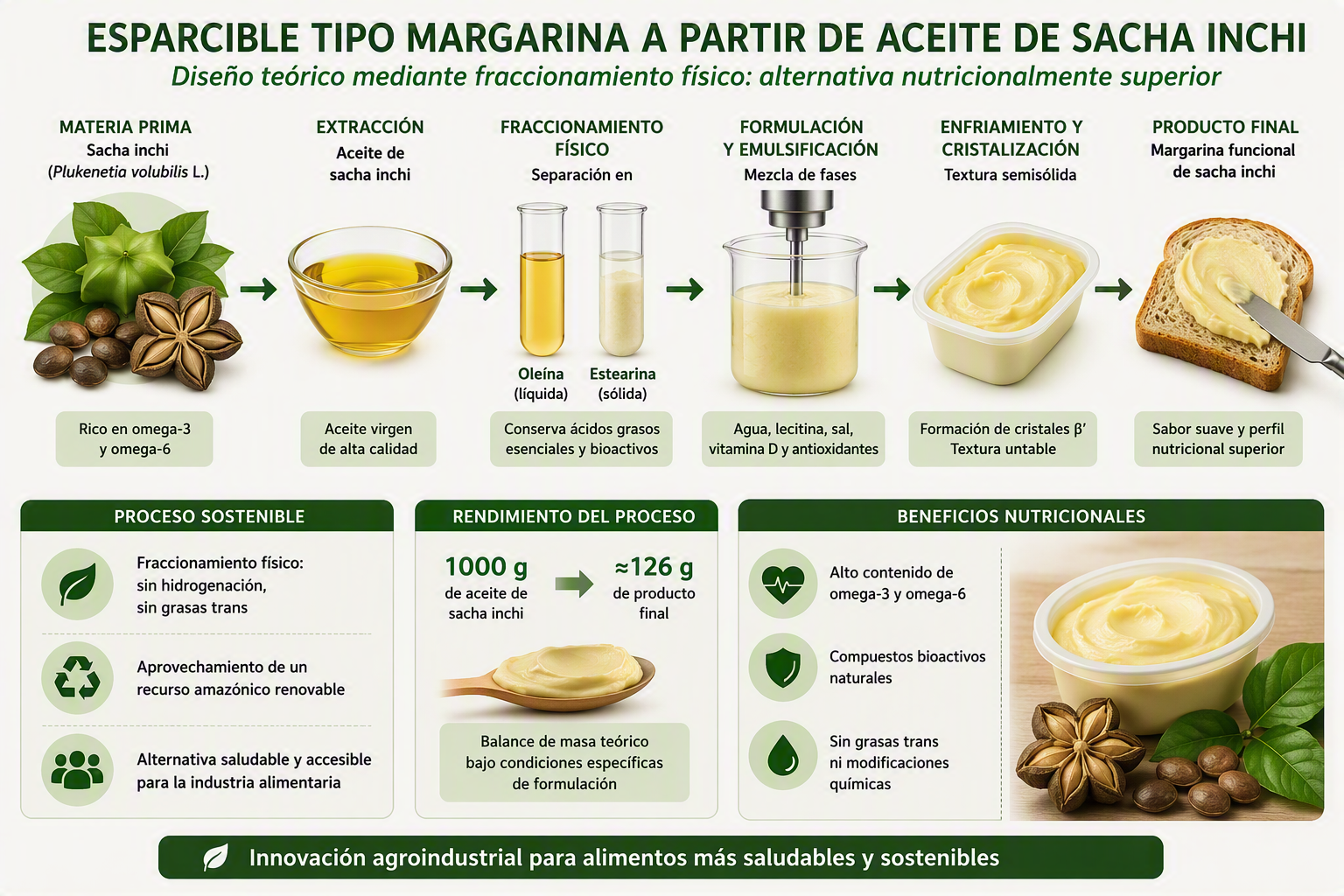
Sacha inchi oil, widely distributed across Amazonian regions of South America, has experienced sustained growth due to its high content of polyunsaturated fatty acids, particularly omega-3 and omega-6, which are associated with beneficial effects on human health. However, its consumption remains limited by its conventional liquid presentation. In this study, a process for producing a spreadable product from sacha inchi oil was theoretically designed, aiming to diversify its forms of consumption and increase its added value. The physicochemical properties of the oil obtained from the Catio-2 variety were analyzed, along with available technological alternatives for lipid structuring without compromising its fatty acid profile. Fractionation was identified as the most suitable method for fat modification, as it preserves essential fatty acids and bioactive compounds through physical processes that do not induce significant chemical changes. Based on a systematic literature review, a base formulation and the required unit operations for producing a spreadable margarine were established. The design included a mass balance showing that, for every 1000 g of sacha inchi oil processed, approximately 126 g of final product can be obtained under specific formulation conditions. Additionally, a process flow diagram was developed, integrating the equipment and operational conditions required for production. The findings suggest the technological feasibility of transforming this oil into a semisolid system with enhanced nutritional properties, capable of competing with conventional commercial products.References
Ashfaq, A., Clochard, M. C., Coqueret, X., Dispenza, C., Driscoll, M. S., Ulański, P. y Al-Sheikhly, M. (2020). Polymerization reactions and modifications of polymers by ionizing radiation. Polymers, 12(12), 2877.
Benítez, R., Coronell, C. y Martin, J. (2018). Chemical characterization sacha inchi (Plukenetia volubilis) seed: oleaginosa promising from the Colombian Amazon. International Journal of Current Science Research and Review, 1(1), 1-12.
Bobo, G., Nicolau‐Lapeña, I. y Aguiló‐Aguayo, I. (2021). Conventional oils and oilseeds: composition and nutritional importance. Oil and oilseed processing: opportunities and challenges, 23-40.
Furlán, L. T. R., Baracco, Y., Lecot, J., Zaritzky, N. y Campderrós, M. E. (2017). Influence of hydrogenated oil as cocoa butter replacers in the development of sugar-free compound chocolates: Use of inulin as stabilizing agent. Food Chemistry, 217, 637-647.
González Cantoñi, D. (2009). Margarina. Valle del Cauca, Colombia: Universidad del Valle, Tecnología en Alimentos, Manejo de Sólidos y Fluidos.
Guo, Y., Cai, Z., Xie, Y., Ma, A., Zhang, H., Rao, P. y Wang, Q. (2020). Synthesis, physicochemical properties, and health aspects of structured lipids: A review. Comprehensive Reviews in Food Science and Food Safety, 19(2), 759-800.
Gutiérrez, C. E. y Vásquez, E. A. (2016). Diseño de sistema automático para la dosificación de margarina en la empresa Lehmä. Bogotá: Universidad Santo Tomás.
Hashempour-Baltork, F., Torbati, M., Azadmard-Damirchi, S. y Savage, G. P. (2018). Chemical, rheological and nutritional characteristics of sesame and olive oils blended with linseed oil. Advanced Pharmaceutical Bulletin, 8(1), 107.
Hendrix, M., Gibon, V. y Calliauw, G. (2016). Modificación de las grasas para agregar valor a los aceites de palma y de palmiste. Revista Palmas, 173-183.
Instituto Colombiano de Normas Técnicas y Certificación [ICONTEC]. (2002). Higiene y seguridad. Colores y señales de seguridad (NTC 241).
Jiménez, D. (2017). Estudio del proceso industrial para la fabricación de margarina. Valladolid: Universidad de Valladolid.
Mattice, K. D., Wright, A. J. y Marangoni, A. G. (2020). Crystallization and rheological properties of milk fat. Advanced Dairy Chemistry, Volume 2: Lipids, 219-244.
Muangrat, R., Veeraphong, P. y Chantee, N. (2018). Screw press extraction of Sacha inchi seeds: Oil yield and its chemical composition and antioxidant properties. Journal of Food Processing and Preservation, 42(6), e13635.
Nguyen, H. C., Vuong, D. P., Nguyen, N. T. T., Nguyen, N. P., Su, C. H., Wang, F. M. y Juan, H. Y. (2020). Aqueous enzymatic extraction of polyunsaturated fatty acid-rich sacha inchi (Plukenetia volubilis L.) seed oil: An eco-friendly approach. LWT – Food Science and Technology, 133, 109992.
Osuna, M. B., Romero, C. A., Romero, A. M., Judis, M. A. y Bertola, N. C. (2018). Proximal composition, sensorial properties and effect of ascorbic acid and α-tocopherol on oxidative stability of bread made with whole flours and vegetable oils. LWT – Food Science and Technology, 98, 54-61.
Panero, M. y Perez, S. (2014). Elaboración de margarina a base de acite de girasol. Argentina: Universidad Tecnológica Nacional.
Saavedra, J. J. H., Silva, B. E. F., Pairazamán, P. I. E. y Minaya, K. Y. C. (2012). Efectos de la ingesta de Plukenetia volubilis Linneo o “Sacha inchi” en el perfil lipídico de adultos jóvenes. Acta Médica Peruana, 29(3), 155-160.
Salas, Y., Tapia, I. y Garzón, M. (2012). Cristalización y plastificación de margarina industrial para panificación. Química Central, 2, 39-47.
Schmidt-Hebbel, H. (1990). Aditivos alimentarios y la reglamentación de los alimentos. Santiago de Chile: Fundación Chile.
Shukla, V. K. (2019). Margarine and baking fats. En Healthful lipids (pp. 665-684). AOCS Publishing.
Singanusong, R. y Jiamyangyuen, S. (2020). Effects of maturity on chemical composition and antioxidant activity of sacha inchi (Plukenetia volubilis L.) cultivated in Northern Thailand. Walailak Journal of Science and Technology, 17(9), 998-1009.
Sivakanthan, S. y Madhujith, T. (2020). Current trends in applications of enzymatic interesterification of fats and oils: A review. LWT – Food Science and Technology, 132, 109880.
Timms, R. E. (2018). Fractionation. En Lipid technologies and applications (pp. 199-222). Routledge.
Tong, S. C., Tang, T. K. y Lee, Y. Y. (2021). A review on the fundamentals of palm oil fractionation: processing conditions and seeding agents. European Journal of Lipid Science and Technology, 123(12), 2100132.
Valenzuela, R., Tapia, G., González, M. y Valenzuela, A. (2011). Ácidos grasos omega-3 (EPA y DHA) y su aplicación en diversas situaciones clínicas. Revista Chilena de Nutrición, 38(3), 356-367.
Wang, S., Zhu, F. y Kakuda, Y. (2018). Sacha inchi (Plukenetia volubilis L.): Nutritional composition, biological activity, and uses. Food Chemistry, 265, 316-328.
Wang, C., Sun, C., Lu, W., Gul, K., Mata, A. y Fang, Y. (2020). Emulsion structure design for improving the oxidative stability of polyunsaturated fatty acids. Comprehensive Reviews in Food Science and Food Safety, 19(6), 2955-2971.
Zhao, Y., Ren, Y., Zhang, R., Zhang, L., Yu, D., Jiang, L. y Elfalleh, W. (2018). Preparation of hydrogenated soybean oil of high oleic oil with supported catalysts. Food Bioscience, 22, 91-98.
Zhu, Q., Pan, Y., Jia, X., Li, J., Zhang, M. y Yin, L. (2019). Review on the stability mechanism and application of water-in-oil emulsions encapsulating various additives. Comprehensive Reviews in Food Science and Food Safety, 18(6), 1660-1675.