
Palabras clave
Polimérico
Glicerol
Espectroscopia
Jatropha
Glycine max
Cómo citar
Resumen
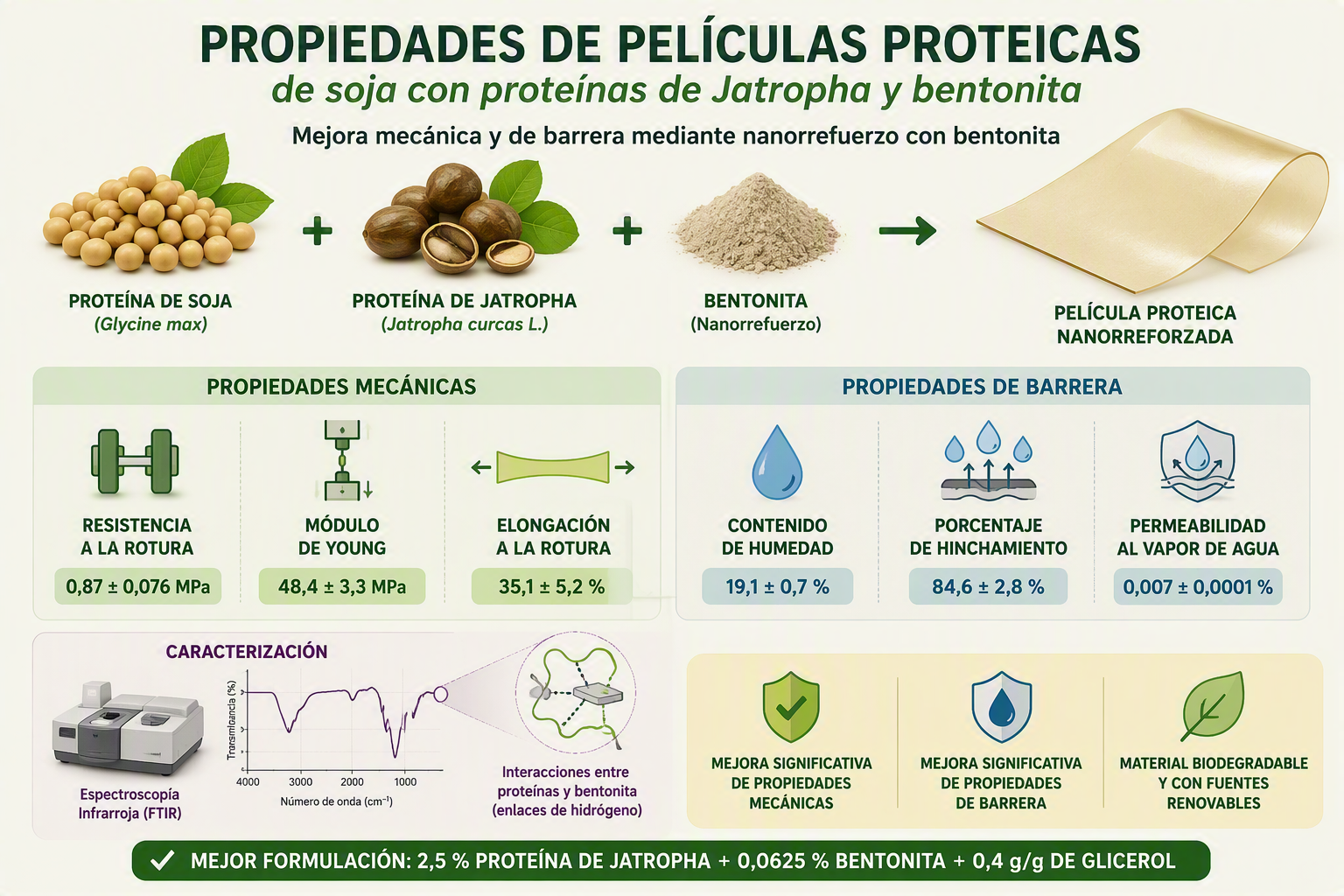
Se evaluó el efecto de la proporción de proteína aislada de Jatropha curcas L. y Glycine max L. en las propiedades mecánicas y de barrera de películas moldeadas, nanorreforzadas con bentonita. Las películas se prepararon con diferentes proporciones de proteína aislada de Jatropha/soja (2,5 %/97,5 % y 5 %/95 %, respectivamente). Además, se añadieron diferentes concentraciones de bentonita (0,1 % y 0,06 %) y una cantidad constante de glicerol (0,4 g/g de proteína). Se observó que la concentración del refuerzo y de la proteína afectan significativamente las propiedades mecánicas de las películas poliméricas. La mejor formulación fue la de 2,5 % de proteína de Jatropha y 0,0625 % de bentonita, obteniéndose valores de resistencia a la rotura de 0,87 ± 0,076 MPa, módulo de Young de 48,4 ± 3,3 MPa y porcentaje de elongación de 35,1 ± 5,2 %. Las propiedades de barrera mejoraron significativamente con esta misma formulación, presentando niveles de humedad de 19,1 ± 0,7 %, un porcentaje de hinchamiento de 84,6 ± 2,8 % y valores de permeabilidad de 0,007 ± 0,0001 %. La caracterización mediante espectroscopia infrarroja permitió identificar la presencia de los grupos funcionales y las interacciones de los compuestos presentes en las películas poliméricas. La adición de bentonita a la matriz proteica mejora significativamente las propiedades mecánicas y de barrera de las películas.Referencias
Abdul-Khalil, H. P. S., Sri-Aprilia, N. A., Bhat, A. H., Jawaid, M., Paridah, M. T., Rudi, D., & Şahin-Nadeem, H. (2013). A Jatropha biomass as renewable materials for biocomposites and its applications. Renewable and Sustainable Energy Reviews, 22, 667–685. https://doi.org/10.1016/j.rser.2012.12.036
AOAC. (2005). Official Methods of Analysis; Association of Oficial Analytical Chemist. Washington, DC.
ASTM. (2010). Standard Test metohd for tensile properties of thin plastic sheeting.
Atarés, L., & Chiralt, A. (2016). Essential oils as additives in biodegradable films and coatings for active food packaging. Trends in Food Science and Technology, 48, 51–62. https://doi.org/10.1016/j.tifs.2015.12.001
Chrissafis, K., Antoniadis, G., Paraskevopoulos, K. M., Vassiliou, A., & Bikiaris, D. N. (2007). Comparative study of the effect of different nanoparticles on the mechanical properties and thermal degradation mechanism of in situ prepared poly(ε-caprolactone) nanocomposites. Composites Science and Technology, 67(10), 2165–2174. https://doi.org/10.1016/j.compscitech.2006.10.027
Elfadly, A. M., Zeid, I. F., Yehia, F. Z., Abouelela, M. M., & Rabie, A. M. (2017). Production of aromatic hydrocarbons from catalytic pyrolysis of lignin over acid-activated bentonite clay. Fuel Processing Technology, 163, 1–7. https://doi.org/10.1016/j.fuproc.2017.03.033
Garavand, F., Rouhi, M., Razavi, S. H., Cacciotti, I., & Mohammadi, R. (2017). Improving the integrity of natural biopolymer films used in food packaging by crosslinking approach: A review. International Journal of Biological Macromolecules, 104, 687–707. https://doi.org/10.1016/j.ijbiomac.2017.06.093
González, A., Strumia, M. C., & Alvarez Igarzabal, C. I. (2011). Cross-linked soy protein as material for biodegradable films: Synthesis, characterization and biodegradation. Journal of Food Engineering, 106(4), 331–338. https://doi.org/10.1016/j.jfoodeng.2011.05.030
Guerrero, P., Retegi, A., Gabilondo, N., & De La Caba, K. (2010). Mechanical and thermal properties of soy protein films processed by casting and compression. Journal of Food Engineering, 100(1), 145–151. https://doi.org/10.1016/j.jfoodeng.2010.03.039
Iman, M., & Maji, T. K. (2012). Effect of crosslinker and nanoclay on starch and jute fabric based green nanocomposites. Carbohydrate Polymers, 89(1), 290–297. https://doi.org/10.1016/j.carbpol.2012.03.012
Karnnet, S., Potiyaraj, P., & Pimpan, V. (2005). Preparation and properties of biodegradable stearic acid-modified gelatin films. Polymer Degradation and Stability, 90(1), 106–110. https://doi.org/10.1016/j.polymdegradstab.2005.02.016
Lambrecht, M. A., Deleu, L. J., Rombouts, I., & Delcour, J. A. (2018). Heat-induced network formation between proteins of different sources in model systems, wheat-based noodles and pound cakes. Food Hydrocolloids, 79, 352–370. https://doi.org/10.1016/j.foodhyd.2017.12.032
Lee, H. G., Kim, G. H., & Ha, C. S. (2017). Polyimide/amine-functionalized cellulose nanocrystal nanocomposite films. Materials Today Communications, 13(August), 275–281. https://doi.org/10.1016/j.mtcomm.2017.10.010
Liu, S., Cai, P., Li, X., Chen, L., Li, L., & Li, B. (2016). Effect of film multiscale structure on the water vapor permeability in hydroxypropyl starch (HPS)/Na-MMT nanocomposites. Carbohydrate Polymers, 154, 186–193. https://doi.org/10.1016/j.carbpol.2016.08.006
Medina-Jaramillo, C., Ochoa-Yepes, O., Bernal, C., & Famá, L. (2017). Active and smart biodegradable packaging based on starch and natural extracts. Carbohydrate Polymers, 176(August), 187–194. https://doi.org/10.1016/j.carbpol.2017.08.079
Monteiro, M. K. S., Oliveira, V. R. L., Santos, F. K. G., Barros Neto, E. L., Leite, R. H. L., Aroucha, E. M. M., Silva, R. R., Silva, K. N. O. (2018). Incorporation of bentonite clay in cassava starch films for the reduction of water vapor permeability. Food Research International, 105, 637–644. https://doi.org/10.1016/j.foodres.2017.11.030
Osorio-Ruiz, A., Solorza-Feria, J., Chiou, B. Sen, Wood, D. F., Williams, T. G., Avena-Bustillos, R. J., & Martínez-Ayala, A. L. (2017). Effect of montmorillonite clay addition on the morphological and physical properties of Jatropha curcas L. and Glycine max L. protein concentrate films. Journal of Applied Polymer Science, 134(7), 1–11. https://doi.org/10.1002/app.44459
Panseri, S., Martino, P. A., Cagnardi, P., Celano, G., Tedesco, D., Castrica, M., Balzaretti, C., Chiesa, L. M. (2018). Feasibility of biodegradable based packaging used for red meat storage during shelf-life: A pilot study. Food Chemistry, 249(August 2017), 22–29. https://doi.org/10.1016/j.foodchem.2017.12.067
Peelman, N., Ragaert, P., De Maulenaer, B., Adons, D., Peeters, R., Cardon, L., Van Impe, F., Devlieghere, F. (2013). Application of bioplastics for food packaging. Trends in Food Science and Technology, 32, 128–141. https://doi.org/10.1016/j.tifs.2013.06.003
Popović, S., Peričin, D., Vaštag, Ž., Lazić, V., & Popović, L. (2012). Pumpkin oil cake protein isolate films as potential gas barrier coating. Journal of Food Engineering, 110(3), 374–379. https://doi.org/10.1016/j.jfoodeng.2011.12.035
Rhim, J. W. (2011). Effect of clay contents on mechanical and water vapor barrier properties of agar-based nanocomposite films. Carbohydrate Polymers, 86(2), 691–699. https://doi.org/10.1016/j.carbpol.2011.05.010
Rhim, J. W., Park, H. M., & Ha, C. S. (2013). Bionanocomposites for Food Packaging Applications. Progress in Polymers Science, 38(10–11), 1629–1652. https://doi.org/10.1016/B978-0-12-811942-6.00018-2
Saurabh, C. K., Gupta, S., Bahadur, J., Mazumder, S., Variyar, P. S., & Sharma, A. (2015). Mechanical and barrier properties of guar gum based nano-composite films. Carbohydrate Polymers, 124, 77–84. https://doi.org/10.1016/j.carbpol.2015.02.004
Wakai, M., & Almenar, E. (2015). Effect of the presence of montmorillonite on the solubility of whey protein isolate films in food model systems with different compositions and pH. Food Hydrocolloids, 43, 612–621. https://doi.org/10.1016/j.foodhyd.2014.07.022
Wang, N., Zhang, X., Han, N., & Bai, S. (2009). Effect of citric acid and processing on the performance of thermoplastic starch/montmorillonite nanocomposites. Carbohydrate Polymers, 76(1), 68–73. https://doi.org/10.1016/j.carbpol.2008.09.021
Wang, W., Zhang, H., Jia, R., Dai, Y., Dong, H., Hou, H., & Guo, Q. (2018). High performance extrusion blown starch/polyvinyl alcohol/clay nanocomposite films. Food Hydrocolloids, 79, 534–543. https://doi.org/10.1016/j.foodhyd.2017.12.013
Yun, Y. H., Youn, H. G., Shin, J. Y., & Yoon, S. Do. (2017). Preparation of functional chitosan-based nanocomposite films containing ZnS nanoparticles. International Journal of Biological Macromolecules, 104, 1150–1157. https://doi.org/10.3969/j.issn.2095-4344.2017.32.010
Zhou, M., Liu, Q., Wu, S., Gou, Z., Wu, X., & Xu, D. (2016). Starch/chitosan films reinforced with polydopamine modified MMT: Effects of dopamine concentration. Food Hydrocolloids, 61, 678–684. https://doi.org/10.1016/j.foodhyd.2016.06.030